
What Is Salesforce Loyalty Management & How It Works
Let’s be honest, most loyalty programs are forgettable. Customers join, earn a couple of points, then forget about them and move forward. The brands invest in such programs and question why the retention numbers are not increasing. It is not a problem with the existence of loyalty programs. The problem is the feasibility of construction and management.
Customers stay when they feel that they are appreciated and when the rewards are applicable, experiences are personal, and when connecting with the company is not limited to a discount code. They spend more time; they refer to others. It is the distinction between the loyalty program that looks good on paper and the one that will be effective.
According to Markets and Markets, the global loyalty management market is on track to grow from $11.4 billion in 2024 to $25.4 billion by 2029 — proof that businesses worldwide are taking customer retention far more seriously than before.
It is to this shift that Salesforce Loyalty Management is constructed. It is not merely a rewards tool, but a complete scale platform, which can assist companies to design smarter programs, get to know their customers, and provide them with experiences that will make them come back.
So, What Exactly Is Salesforce Loyalty Management?
In its most basic understanding, Salesforce Loyalty Management is a dedicated platform which allows firms to build, execute, and streamline loyalty programs both in B2B and B2C aspects.
It is an in-native application on the Salesforce Customer 360 platform and, therefore, does not work in isolation. All the customer information, whether it is the sales, service, relationship with the marketing environment, or the browsing history, is all fed into the loyalty program, providing the brands with an actual whole picture of who their customers are and what they are interested in.
It is also integrated with Salesforce Digital 360 as it integrates with Salesforce Marketing Cloud, Salesforce Service Cloud, and Salesforce at large. It is that native level of connectivity that makes Salesforce Loyalty Management stand out from third-party loyalty tools, which have to make a mess of third-party integrations to communicate with your CRM.
What is also notable is the fact that it is no code. The marketing and loyalty teams have the capability to create and maintain programs without creating a developer ticket whenever they need to change a promotion or modify a tier threshold. That is the only thing that will alter the rate of responsiveness of brands to their customers.
How Does Salesforce Loyalty Management Actually Work?
Consider Salesforce Loyalty Management as the engine that makes every interaction with customers run in the background. This is what it should look like in action – as soon as you have a customer on your program, as far as you may go to streamline it to achieve higher returns.
Step 1: Member Enrollment
The initial point is enrolment. A customer becomes a part of your Salesforce Loyalty Program – via your website, application, in-store, or a different channel. Their profile is generated automatically, and henceforth, all interactions are monitored, and it is attributed to that member.
Step 2: Data Collection Across Every Touchpoint
As soon as a member is signed up, Salesforce Loyalty Management starts collecting information in all channels that they engage in. Buyer, referrals, application interactions, support communication, etc., are all integrated into the Salesforce Customer 360 platform and inform the response of the program to every individual member. No silos, no gaps.
Step 3: Reward Accrual
Points/another currency of loyalty are accrued according to the rules you make. You dictate what is good and what is bad, the value of each action, and the time the points expire. The Salesforce Loyalty Management automatically tracks and calculates it, and therefore, the members will have a balanced figure with constantly updated figures.
Step 4: Tier Progression
Tiers provide the customers with something to strive towards. The more members interact, the higher the level they advance, Silver, Gold, Platinum, or any other structure of your brand. The higher the level, the more advantageous and it forms a motivational cycle that makes people want to revisit it rather than shift to an opponent.
Step 5: Personalized Experiences
This is where Salesforce Loyalty Management comes quite distinctly. With Salesforce Marketing Cloud Personalization, members get offers and messages that are not general offers to all users but are based on their real behavior and preferences. The right message, right time, and right channel.
Step 6: Redemption and Fulfillment
Members can redeem their rewards without any hassle, either in the form of a discount, access to a special deal, a partner deal, or a product. Salesforce Loyalty Management is programmed to efficiently handle all the redemption procedures, including tracking expiry and fulfillment to the partners, and hence your team does not have to go in search of it.
Step 7: Analytics and Optimization
The Salesforce Loyalty Cloud dashboard provides the program managers with real-time insight into what is working and what is not working. Slots of interest, redeeming patterns, tone shifting, campaigning results – it is all these, and you are well placed to streamline and keep on streamlining instead of quarterly reacting.
Core Features of Salesforce Loyalty Management You Should Know About
Member Management — One Place for Every Member
Salesforce Loyalty Management gives you a centralized hub for managing every member in your program. Individual customers, corporate accounts, and even member groups — where points are pooled and shared across a team or organization — are all managed in one place. Transaction journals record every point earned, redeemed, adjusted, or expired, so nothing falls through the cracks.
For B2B businesses, this is particularly useful. The ability to manage group memberships and pooled rewards makes the Salesforce Loyalty Program a genuinely practical tool for partner programs and enterprise loyalty structures — not just consumer-facing rewards.
Program Setup — Configure It Your Way
This is where the structure of your program takes shape. You define the tiers, set the loyalty currency, build accrual and redemption rules, and determine how the program evolves over time.
One feature that often gets overlooked here is partner integration. Salesforce Loyalty Management allows you to bring external vendors into your rewards ecosystem. Members can earn or redeem points through partner brands — which adds real value to your program without significantly increasing your costs.
Loyalty Experiences — Making It Personal
This is arguably the most powerful part of Salesforce Loyalty Management. It is where personalization moves from a talking point to an actual customer experience.
Brands can set up tier-based perks, trigger milestone rewards when members hit key engagement thresholds, assign digital badges, and run gamified challenges that encourage habitual participation. When connected to Salesforce Marketing Cloud, every one of these experiences can be delivered in a way that feels tailored — not templated.
Why Businesses Are Choosing Salesforce Loyalty Management
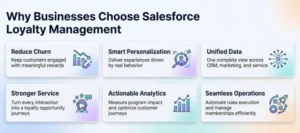
Running a loyalty program is easy. Running one that actually moves the needle on retention, revenue, and customer satisfaction is a different challenge entirely. More and more businesses are turning to Salesforce Loyalty Management because it solves the right problems — not just the surface-level ones. Here is what makes it a genuinely strong choice.
It Reduces Churn Without Heavy Lifting
A well-structured Salesforce Loyalty Management program gives customers a reason to stay that goes beyond price. Tiers create progression. Milestones create moments. Personalized rewards create relevance. Together, they build the kind of emotional connection that makes switching to a competitor feel like a loss — not a neutral decision.
Personalization That Actually Scales
Most businesses know personalization matters. Far fewer manage to deliver it consistently at scale. Salesforce Loyalty Management, when connected with Salesforce Marketing Cloud Personalization, makes this achievable. Customer behavior drives the experience — not assumptions or batch-and-blast campaigns.
No More Data Silos
One of the biggest loyalty program killers is fragmented data. When your CRM does not talk to your marketing platform, which does not talk to your service team, the customer experience suffers — and so does your program’s effectiveness. The Salesforce Customer 360 platform eliminates that problem entirely by giving every team a shared, unified view of each customer.
Service Teams Become Loyalty Advocates
When Salesforce Service Cloud automation is combined with loyalty data, something interesting happens. Service agents can see a customer’s tier, points of balance, and history the moment they open a case. That context changes the quality of the interaction — and when service is good, loyalty follows. Salesforce Loyalty Management makes this connection seamless.
Real Visibility into Marketing Cloud ROI
It is surprisingly common for businesses to run loyalty programs for years without knowing which elements are actually driving value. The analytics built into Salesforce Loyalty Management change that. You can track Marketing Cloud ROI by campaign, tier, segment, and more — giving you the clarity to invest in what works and cut what does not.
Built for Both B2B and B2C
Most loyalty platforms are designed with one audience in mind. Salesforce Loyalty Cloud was built to work across both. Whether you are running a consumer-facing rewards program or managing a complex channel partner incentive structure, the platform adapts without requiring you to work around its limitations.
Which Industries Benefit the Most from Salesforce Loyalty Management?
Salesforce Loyalty Management is industry-agnostic by design — but certain sectors tend to see the strongest results given the nature of their customer relationships and retention challenges. Here is a quick look at where it delivers the most impact:
Retail & E-commerce
- Points-based programs and VIP tiers drive repeat purchases
- Personalized promotions increase average order value
- Omnichannel tracking ensures a consistent experience in-store and online
Financial Services
Rewards card spend, referrals, and policy renewals
Deepens long-term client relationships beyond transactions
Supports both individual and corporate loyalty structures
Healthcare
- Wellness reward programs motivate healthy behaviors
- Keeps patients engaged with health plans and providers between visits
- Encourages consistent app usage and preventive care participation
Telecom
- Reduces churn among high-value subscribers
- Incentivizes plan upgrades and longer contract commitments
- Salesforce Loyalty Cloud supports complex subscription-based tier structures
Travel & Hospitality
- Miles, stays, and status tiers have always been loyalty cornerstones
- Salesforce Loyalty Management brings these programs into the modern omnichannel era
- Real-time personalization enhances the travel experience at every stage
What Does Salesforce Loyalty Management Implementation Look Like?
Livestreaming a program is not an unorganized task, and the quality of that process at its beginning defines the quality of its performance in the long term. This is a typical Salesforce Loyalty Management implementation that is implemented correctly.
Phase 1: Discovery and Strategy
The most significant decisions are made here before any setup is initiated. What do you want the program to accomplish? Who is it for? What is the tier and reward structure? What are the KPIs? One of the most frequent causes of the under delivery of loyalty programs is the inability or rushedness to complete this stage; therefore, it should be given serious consideration.
Phase 2: Program Configuration
This is where the program is developed within Salesforce Loyalty Management. All the tiers, loyalty currencies, accrual and redemption rules, partner integrations, and member onboarding flows are all configured according to the strategy established in Phase 1.
Phase 3: System Integration
The Salesforce Loyalty Cloud gets hooked to the wider ecosystem – Salesforce Marketing Cloud, Salesforce Service Cloud, your commerce platform, and any other external systems such as point-of-sale, mobile applications, or third-party data providers. This is the place where technical skills are of the utmost importance and where the role of an experienced Salesforce CRM development company can contribute greatly.
Phase 4: Testing and Quality Assurance
All the rules, member journeys, data flow, and integrations are put to the test before going live. It is a phase that grabs the problems that would otherwise be experienced as frustrating member experiences once it is launched, thus it is never a shortcut stage.
Phase 5: Launch and Ongoing Optimization
The starting point is not going live but rather the beginning point. After the launch, it is time to pay attention to the monitoring of the program’s performance, to analyze the behavior of the members by using the Salesforce Loyalty Cloud dashboard, and to introduce continuous improvements. The optimal programs are those that are developed over a period of time, and having the right Salesforce development services partner means that optimization is not an afterthought.
The difference between having an experienced Salesforce Loyalty Management consulting group on board to go through this process with and without it is significant. The appropriate partner will add technical depth and strategic acumen, assist in avoiding the configuration errors that result in programs not running well on the first day.
Conclusion
Customer loyalty is not something you can buy with a discount — it has to be earned through consistent, relevant, and rewarding experiences. Salesforce Loyalty Management gives businesses the platform to do exactly that, combining data, automation, and personalization in a way that makes loyalty programs genuinely effective rather than just technically functional.
At AnavClouds Software Solutions, we help businesses implement Salesforce Loyalty Management end-to-end — from program strategy to go-live and beyond. As a Salesforce Silver Consulting Partner, we bring the expertise to get it right the first time. Talk to Our Salesforce Experts and let’s build something your customers want to be part of.
Frequently Asked Questions
What is Salesforce Loyalty Management?
Salesforce Loyalty Management includes a Salesforce-native platform assisting companies in investment, administration, and optimization of loyalty programs – inspiring customer retention, individualized reward schemes, and enduring interaction.
How does Salesforce Loyalty Management help retain customers?
It applies tiered rewards, customized offers, and behavior data to keep the customers active – and they have a steady reason to prefer to use your brand instead of the competitors.
Is Salesforce Loyalty Management suitable for small and large businesses?
Yes. The platform is scalable and flexible – This is because it is a good fit for businesses of all sizes in terms of both B2B and B2C industries.
Does Salesforce Loyalty Management integrate with other Salesforce products?
Absolutely, it is natively connected to both Salesforce Marketing Cloud and Salesforce Service Cloud and to the Customer 360 platform – unifying the connected loyalty experience across touchpoints.